
Framed vs Load Bearing Structures in India: Understanding the Difference
When we talk about building construction in India, two common structural systems come into the picture — Framed Structures and Load Bearing Structures. Both methods have been widely used for decades, but they differ in how they transfer loads, their cost, materials, and suitability for different types of projects. Let’s understand both in simple terms.
Er. Sahil Dogra
10/26/20253 min read
1. What is a Load Bearing Structure?
A Load Bearing Structure is one of the oldest forms of construction. In this system, the walls themselves carry the entire weight of the building, including the roof, floors, and any additional loads.
In simple words, the walls act as the main structural elements, and there is no separate frame made of beams and columns.
Common Features:
Walls are thick and made of brick or stone masonry.
There are no RCC columns or beams.
The load from the roof and slabs is transferred directly through the walls to the foundation.
Advantages:
Simple design and construction process.
Cost-effective for small buildings (usually up to two or three floors).
Uses locally available materials like bricks, stones, and cement mortar.
Good thermal and sound insulation due to thick walls.
Disadvantages:
Not suitable for high-rise buildings.
Reduces usable space because of thick walls.
Difficult to modify or extend later.
Slower construction speed compared to modern methods.
Where It’s Commonly Used:
Load-bearing construction is still common in rural areas, small towns, and low-rise residential buildings across India. It’s preferred for homes where budget and simplicity are key priorities.
2. What is a Framed Structure?
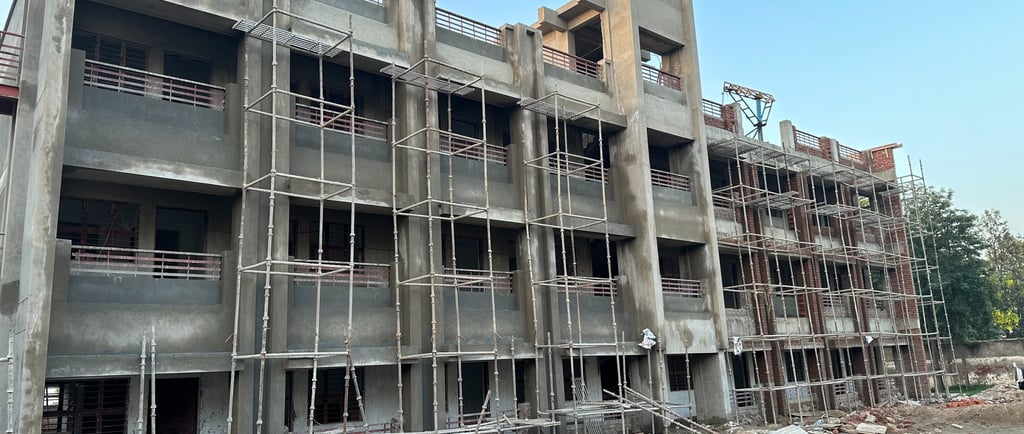
A Framed Structure is a modern system where beams, columns, and slabs made of Reinforced Cement Concrete (RCC) or steel form the structural skeleton of the building.
Here, the frame carries the entire load, and walls are only used for partition and aesthetics — not for bearing structural loads.
Common Features:
Uses RCC or steel as the main structural material.
Columns and beams form a frame to support slabs and roofs.
Walls are thin and non-structural, often made of bricks or blocks.
Advantages:
Can be used for multi-storey and high-rise buildings.
Flexible design — walls can be moved or modified without affecting structure.
Faster construction using modern techniques.
More earthquake-resistant when designed properly.
Better space utilization due to thinner walls.
Disadvantages:
Higher initial cost compared to load-bearing structures.
Requires skilled labor and proper engineering design.
Depends heavily on quality of materials and construction practices.
Where It’s Commonly Used:
Framed structures are used in urban areas, commercial complexes, apartments, schools, hospitals, and industrial buildings — basically, wherever strength, flexibility, and height are important.
3. Major Differences Between Load Bearing and Framed Structures
The key difference between a load-bearing structure and a framed structure lies in how they carry building loads. In load-bearing structures, the walls themselves support the entire weight of the building and transfer it to the foundation. This makes them suitable for small, low-rise houses, especially in rural or semi-urban areas. Framed structures, however, use a framework of beams and columns to carry the load, with walls serving only as partitions. They are ideal for multi-storey buildings, commercial projects, and earthquake-prone regions, offering more flexibility in design and better use of space.
4. Which System is Better for You?
The choice between a load-bearing and a framed structure depends on your budget, location, soil type, and building height.
If you are building a small house (1–2 storeys) in a low-seismic zone, a load-bearing structure can be a cost-effective option.
But if you plan for multi-storey construction, commercial use, or live in an earthquake-prone area, a framed structure is a much safer and more durable choice.
5. Indian Context and Trends
In India, load-bearing structures were common in traditional homes and colonial-era buildings. However, with urbanization, the trend has shifted towards RCC framed structures due to their strength, flexibility, and suitability for vertical growth.
Modern architects and engineers prefer framed structures for cities, while load-bearing systems still hold value in rural or budget-sensitive projects.
6. Conclusion
Both systems have their own importance in construction.
Load-bearing structures symbolize simplicity and economy, while framed structures represent strength, innovation, and modern design.
Choosing the right system depends on what you value more — cost and tradition, or durability and flexibility.
Whichever you choose, good design and proper execution are the keys to a safe and lasting structure.